There’s no denying AI is changing our professional lives.
It excels at automating the mundane and simplifying the complex and, used well, it can free creative people to do what they do best. The question isn’t whether to use it, but whether we’re being intentional about where human judgement remains irreplaceable.
The creative industry it seems, loves ‘faster’. The holding companies especially seem drawn to the promise of ‘faster, better, cheaper’ – a model that risks treating human judgement as an inefficiency to be engineered out rather than an advantage to be amplified.
I would agree, in some instances, this is the right thing to do. For example, when dealing with a linear process where 1+1=2.
However, humans (especially creative ones), are rarely linear. We are messy, irrational creatures and sometimes to do things better, we need to set loose our superpower – imagination.
You see, imagination separates us from everything else (carbon or silicon based) on the planet. Imagination is a time machine that enables us to see the future and uncover opportunities.
The power of imagination is tremendous… and it can be magnified exponentially when people take time out, come together, share, learn, and collaborate.
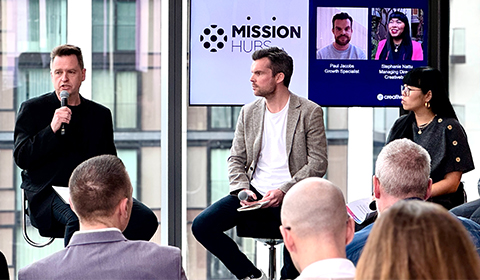
And this is why we host the MISSION Hubs Forum – this year, in Montreal with our Partners, The Humanise Collective.
The Forum is a three-day event at which our Agency leaders, partners and invited experts deep dive into the issues that matter to them, their businesses and our industry.
Issues like, the move to the empathy economy.
As Mitch Joel, Co-Founder, ThinkersOne explained, in an age of democratised AI access, the competitive advantage shifts upstream to better judgement, better taste, stronger relationships and more meaningful experiences. AI can remove friction from processes, but creative humans must still create meaning.
A sentiment echoed by Creative Strategist, Klaus Sommer Paulsen of Adventure Labs, an expert in integrated storytelling, who warned that the real risk isn’t AI generated creative, but rather humans settling for convenience in the process and ‘good enough’ thinking replacing originality and empathy derived insights.
But as explored in a panel discussion with David Payne, Global Chief Partnerships Officer at Billups, Ana Carrapichano, CEO, Mediology and Sarah Thompson, Executive Managing Director, Glassroom Toronto, AI can also bring very distinct benefits to the media side of the industry – especially out-of-home where programmatic placement can now be coupled with real-time inventory reporting – “the billboard now has a brain”.
Naturally, no meeting of Agency leaders would be complete without discussing commercial models. In this instance, a hornet’s nest poked brilliantly by Michael Farmer, Chairman & CEO, Farmer & Company, who described how the traditional ‘pay per hour’ model has been broken for 30+ years as Agency workloads have doubled, whilst fees have halved. Michael suggested Agencies must learn to measure work accurately, understand the ‘cost-of-production’ and charge for outputs and not time.
Ultimately, as Meera Sharath Chandra, Founder, CEO & COO of Tigress Tigress shared, we should never lose sight of her simple equation – C>B >A, customer before brand, brand before advertiser. This is how we create truly empathy driven communications, that connect and motivate action.
So, I guess, whilst a fast horse might get you there quicker, it’s only worthwhile if you ultimately know where you are going… and, let’s be honest, all journeys are more fun in good company!
It’s exactly this belief – that human creativity, imagination and collaboration remain the only competitive advantages that cannot be commoditised – that sits at the heart of everything we do across the MISSION Group.
Paul Squirrell
Managing Director, MISSION Hubs